










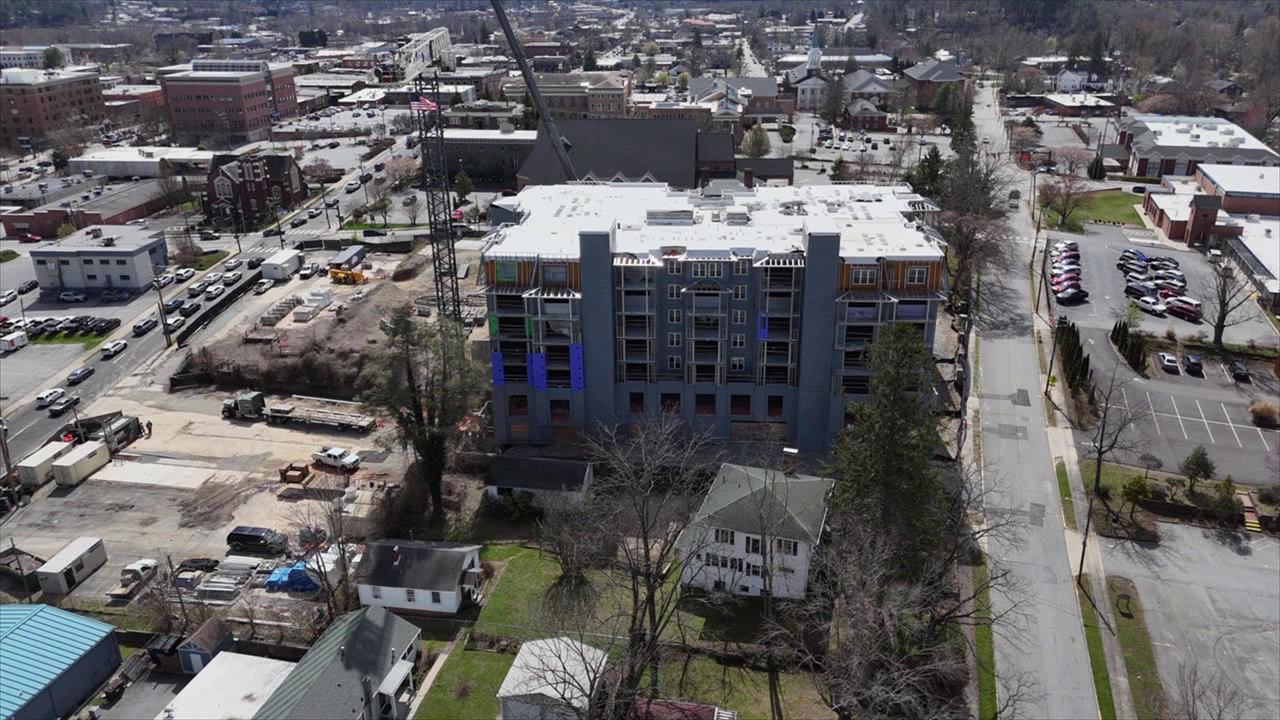
HENDERSONVILLE, N.C. (WLOS) — A judge ruled Thursday that condo buyers in the failed luxury project in Hendersonville have no legal basis to challenge the property's $36 million sale to a construction loan lender. Court proceedings show that some buyers put their life savings down as deposits for units in the project.
North Carolina Business Court Judge A. Graham Shirley ruled that Fuse 10, LLC provided a $32 million construction loan for the failed Fairmont Heritage Place The Cedars project, conceived by Miami-based developer Greg Covin.
The loan is now in default with accruing charges, including interest. During court proceedings in recent weeks, attorneys for Fuse 10 said the company plans to nationally market and sell the property by contracting with national real estate firm Marcus and Millichap.
While the judge approved the sale, the ruling in essence officially allows Fuse 10 to assume ownership of the lot rather than writing another check to buy it.
In his ruling, Shirley laid out his reasoning despite a challenge from a group of condo buyers represented by attorney Paul Capua.
Shirley wasn't convinced by Capua's arguments that condo owners who paid deposits had any legal right to halt the lot's sale to Fuse 10.
The judge noted numerous other creditors who have been left unpaid. They include Turner Construction, which pulled out a huge crane from the site months ago, ceasing work due to unpaid bills by the developer.
In his ruling, Judge Shirley laid out the stipulations that condo buyers agreed to when they put down their deposit money. Shirley stated the contract language allowed Greg Covin and Cedars Lodge and Spa, LLC to use the money for construction of the failed Tower 1.
"The condo purchasers knew at the time construction deposits were made that, unless they rescinded within seven days as required by the North Carolina Condominium Act, those construction deposits would be used for construction," Shirley wrote. "They (condo owners) have presented none of the 'special factors' that justify imposition of an equitable lien under this theory. There were also no allegations of fraudulent use of the construction deposits, therefore the relations between the condo purchasers and Cedars Lodge do not include any special circumstances warranting the decree of an equitable loan."
"Once again, the condo purchasers present no argument that the construction deposits were not validly used by Cedars Lodge," Shirley wrote.
The judge said the sale proposed by the receiver appointed to represent lender Fuse 10's interests "presents the best chance to obtain proceeds for the various creditors in this action." Shirley said his ruling doesn't put the condo purchasers in any worse position with respect to any hypothetical lien rights.
While the judge has approved the lot sale to Fuse 10, the proceeding, according to attorneys familiar with real estate law, is considered a standard step for a lender with an entity in default for a construction loan.
A developer familiar with the property tells News 13 that the true value of the site will only be made clear if a group or company decides to bid to buy the property, which he feels has a more realistic value of around $10 million. Attorneys familiar with default loan proceedings say a lender will take a property into ownership and then try to sell it to the highest bidder.
In his ruling, Judge Shirley signed off on the request rather than denying it and having the property go directly into foreclosure.
The judge said Cedars owns eight land tracts in Hendersonville that the group was trying to develop as luxury high-end condos associated with the Fairmont Hotel brand, best known for the group's flagship historic hotel in San Francisco.
Court proceedings have revealed some purchasers put down as much as a million dollars as a deposit on a unit.
In his brief, Shirley said the Cedars Fairmont group had approximately 43 condo buyers who entered into purchase and sale agreements (PSAs).
"The PSAs required each condo purchaser to make certain deposits (the "construction deposits") that were then placed in escrow until the condo purchasers' right of rescission under applicable law had expired."
Judge Shirley stated the window was seven days of hold in escrow per the PSA contracts. After that time, Shirley stated in his ruling the builder was allowed to use the construction deposits for "any costs, fees, or expenses related to the construction of the residential condominium (and unit)." Under the law, Shirley wrote, condo buyers within seven days of their deposits had the right to cancel the PSAs and get their money back.
STORY COURTESY OF WLOS-TV13
